Statutory-ready ISPs. Built into your SENDCo's daily work.
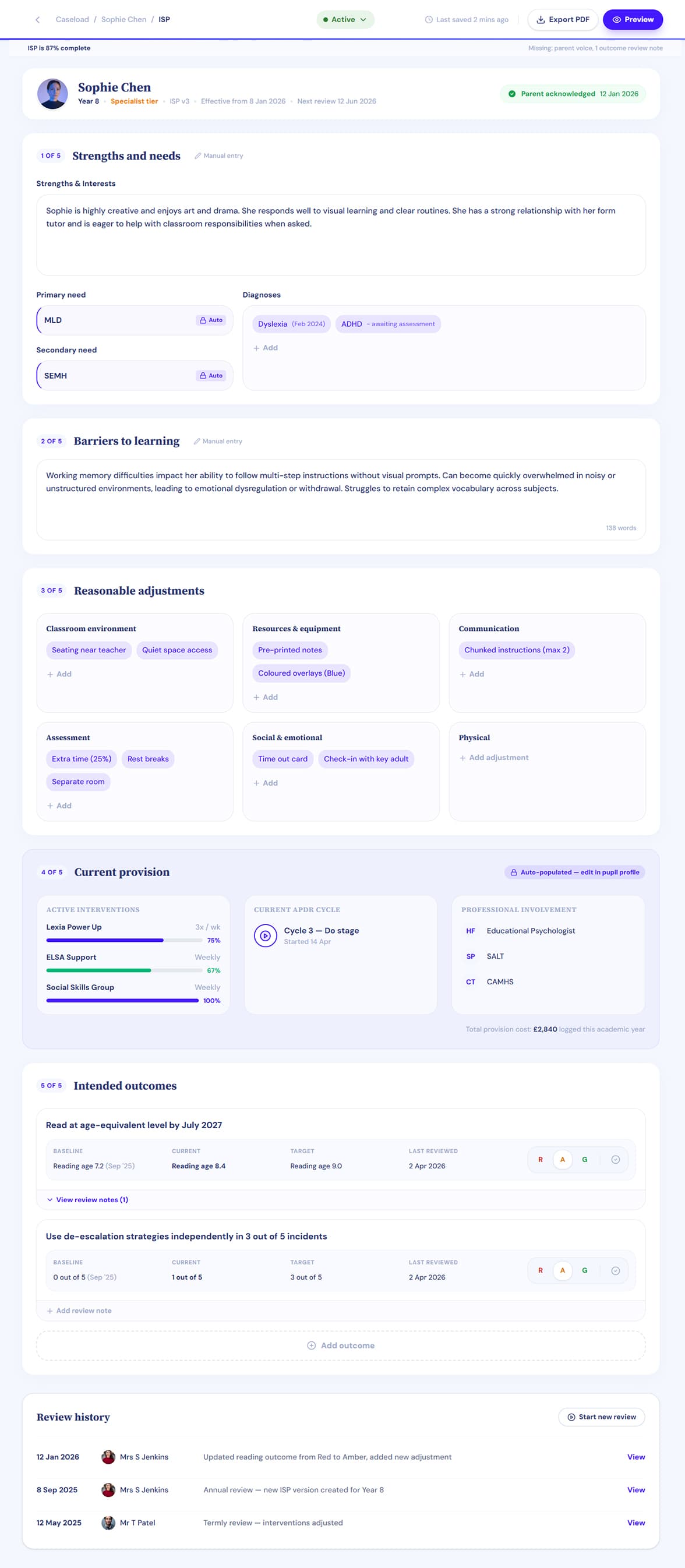
Five sections. Termly APDR review prompts. Parent voice fused in. Outcomes RAG-rated and tracked over time. Everything the SEND Reform White Paper requires, and the bits the White Paper doesn't mention but Ofsted will look at.
Every SEN Support pupil needs a statutory ISP by September 2029.
The SEND Reform White Paper makes Individual Support Plans a legal requirement for the 1.7 million children currently on SEN Support. ISPs must be:
- Digital. No more Word documents in shared drives.
- Co-produced with parents, and the contribution must be evidenced.
- Reviewed annually at minimum, with most schools moving to termly APDR cycles.
- Structured to a national format. DfE is developing the schema, expected 2027.
SENDCo View is built to that emerging schema, with the structure already locked in.

Five sections. Mapped to the DfE schema.
Strengths and needs
What the pupil is good at, what they find hard.
Barriers
What's stopping them from learning right now.
Provision
What the school is doing about it.
Outcomes
What success looks like, by when, RAG-rated.
Review
What happened, what changed, what's next.
Assess. Plan. Do. Review. Every term.
The graduated approach is a cycle, not a one-off. SENDCo View supports every stage with the live data and prompts a SENDCo needs.
Assess
Pulls live MIS data, surfaces what's changed since the last cycle.
Plan
Uses the previous cycle's outcomes to seed the new one.
Do
Intervention log accumulates as staff work.
Review
Termly prompt to the SENDCo, parent voice fused in from the portal.
And then back to Assess. Every term. Every pupil.
What ISP automation does.
Statutory structure built in
Five sections, mapped to the DfE's emerging national schema. As the schema firms up, your ISPs adapt automatically.
Termly review prompts
Three times a year, SENDCo View prompts the SENDCo to review each pupil's plan. Nothing slips. The audit trail is automatic.
Outcomes that don't get forgotten
Outcomes are RAG-rated, with target dates. They appear on the pupil profile, on the SENDCo dashboard, and in the next review. They're the thread the LA will follow.
Four steps. Termly cadence.
Pupil flagged on SEN Support
SENDCo opens a new ISP from the pupil profile.
Five sections filled in
Strengths, needs, barriers, provision, outcomes, review. Pre-populated where data exists.
Parent invited
One-click invitation through the parent portal for co-production.
Termly review
Automatic prompt at the start of each term, parent voice fused in.
Common questions about ISPs.
What's the difference between an ISP and an IEP?
What if the DfE changes the ISP schema?
Can we still use our existing IEPs?
Do parents have to use the portal?
What about pupils with EHCPs?
Parents contribute to every ISP review through the portal. See how →
EHCP evidence packs are generated from the same data. See the sample →
Want to see this in your school? Apply for a founding place →